
Opinion: There is a particular kind of insult built into the Trump administration’s late-election conduct. It is not merely that voters are asked to accept extraordinary claims. It is that we are asked to forget what we have just watched.
Forget the difference between an accusation and proof. Forget who controls elections under our constitutional system. Forget that the Department of Justice is supposed to serve the country, not the candidate a president wants to rescue. Forget that a search warrant is not a conviction, and that a pardon is not an acquittal. Forget the evidence when it complicates the story; accept the story when the evidence is thin.
With eight days before the November 3 midterm election, Americans are being given a test. The question is not whether we care about election security, public corruption, immigration enforcement or public safety. We should. The question is whether those concerns may be used as a fog machine—something that hides selective power behind the language of law and order.
We are not stupid. We can see the pattern.
A Justice Department lawsuit for one Senate seat
Start in Alaska. The Justice Department has sued to prevent certification of the state’s U.S. Senate result in a narrow set of circumstances: if the outcome is affected by a second candidate named Dan Sullivan and the Republican incumbent loses. The administration says the second candidate could confuse voters. President Donald Trump did not leave the political connection obscure. He said he told the Justice Department to bring the case.
The name-confusion question is not imaginary; ballot design can matter, and courts can hear genuine election disputes. But the source of this lawsuit matters. It was not a private candidate protecting a personal ballot-access interest. It was the federal government, directed by a president, trying before Election Day to create a path to stop certification of a competitive Senate race if its preferred incumbent loses narrowly.
That is not ordinary. It is a warning about what this administration thinks counts as a neutral use of federal power. A president who lost in Alaska by a landslide could tell the state to clarify its ballot or urge Congress to modernize election law. Instead, he directed his Justice Department toward the certification of a race whose result he does not yet know.
The point is not that voters are incapable of distinguishing two names. The point is that the administration seems to believe voters will not distinguish a legitimate concern about a ballot from a president using federal litigators to protect a political ally.
The evidence is always just around the corner
The same habit appears in the federal voter-roll campaign. It is lawful—and necessary—for states to maintain accurate rolls. It is a federal crime for a noncitizen to vote in a federal election. Those facts are not in dispute.
What is in dispute is whether an untested federal data match should be allowed to withhold a ballot from a voter days before an election.
The Justice Department says it identified more than 20,000 people it believes are likely noncitizens on California’s rolls and has demanded that California set aside ballots connected to those names while their citizenship is determined. California officials contest the reliability and legal sufficiency of that demand. On October 26, a federal appeals panel questioned its timing, constitutional footing and authority. That is the responsible vocabulary for this moment: alleged, contested, to be reviewed. A government press release is not a court finding, and a list is not a verdict.
The number should be put in its proper scale. Twenty thousand alleged registrations—none of which the government has established as unlawful—cannot explain away or invalidate a national midterm in which roughly 130 million Americans may vote. A genuinely close local contest still deserves careful, lawful verification. But that is a reason for evidence and due process, not a reason to cast suspicion over a national election. The political value of the 20,000 figure is not that it proves a nationwide outcome; it is that it can be repeated until people begin to doubt whether any outcome is legitimate.
Nevada supplied the clearest warning against treating a number as proof. Federal officials initially said as many as 15,903 noncitizens might be on Nevada’s voter rolls. The number later fell to 185 potential cases sent to the state. Nevada officials said every one of those 185 voters was a U.S. citizen.
That does not prove that every voter file in America is perfect. It proves something much more useful: a dramatic claim can dissolve when it meets ordinary verification. Yet the original claims did their political work before the checking was complete. In July, Homeland Security Secretary Markwayne Mullin also warned state officials that noncompliance could bring fines, penalties, or even prison, depending on the circumstances.
Threatening election officials does not strengthen weak data. It makes the public ask whether the goal is accuracy or submission.
We are not stupid. We can see the pattern.
A demand letter is not a badge of infallibility
California’s county registrars received federal letters demanding that they sequester ballots tied to the government’s list. Local officials reported confusion and alarm; the administration describes the step as election-integrity enforcement. Both sides can agree on a basic principle: eligible voters should not be disenfranchised because a federal database may be wrong.
That safeguard is not a partisan loophole. It is due process. Records can be old, incomplete, mismatched or incapable of showing a change in citizenship. Election administration has rules for notice, verification and correction precisely because a mistake made in the final days before an election may not be fixable after Election Day.
The government’s message is therefore upside down. Rather than showing verified evidence and allowing officials to do their jobs, it has often issued a large number, announced an emergency, and demanded that local election workers prove the government right under deadline and threat. The public is told to call that confidence. It looks more like pressure.
Monitoring is lawful. This scale demands neutrality.
The Justice Department has long monitored elections to assess compliance with federal voting-rights laws. That function can protect voters. The department’s own guidance says monitors observe election-day activity; they do not run an election, decide a voter’s eligibility or direct local administrators.
But this is not a routine deployment. The department plans to send a record 1,000 monitors to polling places and ballot-counting locations for the midterms—more than three times the 289 monitors it sent for the 2022 midterms, and even more than the 714 personnel reported for the 2024 presidential election. The number alone does not prove misconduct. It does mean the public is entitled to know who is being sent where, under what criteria, with what training and with what safeguards against political interference.
Those questions are not hypothetical. In the primaries, officials in several states raised concerns about access, authority and conduct. Wyoming’s Republican governor asked for an investigation after describing some monitor behavior as aggressive and irregular. In Colorado, a county clerk said he believed a proposed deployment was meant to intimidate voters in a competitive district. Those are allegations, not findings that every monitor acted improperly. They are nevertheless reason for transparent rules and independent oversight.
Federal monitors must be nonpartisan in practice, not merely in title. They should be clearly identified, trained on state law, kept outside partisan activity, prohibited from questioning or challenging voters, and accountable to local election rules and courts. A monitoring program that concentrates in communities already targeted by the administration’s voter-fraud rhetoric—or treats a close race as a reason to pressure local officials—will understandably be seen as partisan, whatever label Washington puts on it.
The rule of law must apply when the target is unpopular
The October search of Rep. Ilhan Omar’s Washington home needs the same discipline. The Justice Department says Homeland Security Investigations executed a judicially authorized warrant as part of an ongoing criminal investigation; reporting says the inquiry concerns potential fraud in family immigration paperwork. Omar denies wrongdoing and says she is being targeted as a political enemy. No charging decision or finding of guilt has been announced.
Two facts can be true at once. A judicial warrant is a legal process, not proof that the target is guilty. And the use of law enforcement against a sitting member of Congress demands heightened public scrutiny when the president and vice president have repeatedly singled her out with unsubstantiated accusations and hostile rhetoric, including about her Somali origin.
The honest position is not to declare Omar innocent or guilty from a headline. It is to insist that law enforcement be judged by evidence, ordinary procedure and equal treatment—not by who has become a convenient political symbol. If the administration wants the public to trust the investigation, it should understand why its own rhetoric makes that trust harder to earn.
The intended reach of such a display is wider than one elected official. A naturalized citizen, a Muslim voter, a Somali American family, or anyone already made to feel suspect can see a powerful government publicly pursue a prominent member of that community and ask a simple, chilling question: Could that happen to me? Fear does not have to produce an arrest to change civic behavior. It can make a person avoid a polling place, decline to volunteer, decide not to speak, or consider staying home altogether. That damage touches every eligible American because intimidation works by teaching the public that political participation may carry a personal cost.
We are not stupid. We can see the pattern.
A frightening story is not a factual explanation
Now consider France. After unrest there, Trump and prominent Republicans have presented images of violence as proof that immigrants, Muslims and “open borders” are to blame—and as a warning of what Democrats will bring to the United States. The Associated Press found those claims unsubstantiated. France’s unrest has been tied to student protests over education, cost-of-living pressures and political conflict; opportunistic violence occurred, but that does not turn a complex national crisis into a one-word immigration parable.
The political move is familiar: take a frightening image from overseas, strip away its context, then use it to frighten voters at home. It asks Americans to react rather than think.
That is not a serious argument for border policy. A serious argument can address asylum rules, enforcement capacity, labor markets, citizenship, integration and public safety with facts. It does not need to turn every immigrant into a suspect or every foreign protest into a campaign commercial.
Islamophobia is not an election strategy we should accept
There is an even more explicit version of this tactic: using Muslim identity itself as an alarm bell. At a Michigan rally, Trump repeatedly called Senate candidate Abdul El-Sayed a “jihadist” and claimed he was tied to the Muslim Brotherhood, without offering evidence. El-Sayed is Michigan-born. Calling a Muslim American candidate disloyal or dangerous on the strength of his faith, name or heritage is not policy analysis. It is Islamophobia.
The Muslim Brotherhood is a real and varied international movement. In January, the State Department designated specified branches in Lebanon, Egypt and Jordan under U.S. counterterrorism authorities. That action is not a license to use “Muslim Brotherhood” as a smear against an American candidate with no demonstrated connection to those groups. A government can identify particular organizations and their conduct; it cannot honestly convert a religious identity into evidence of guilt.
That distinction matters because the rhetorical pattern is deliberate. A report from Rutgers’ Center for Security, Race and Rights documents how Muslim American candidates have been cast as foreign, dangerous or secretly disloyal in U.S. electoral politics. The allegation needs no proof to do its work. It asks an audience to hear “Muslim,” “immigrant” or “Brotherhood” and fill in the most frightening blank available.
Americans should refuse the invitation. Muslim Americans are neighbors, voters, public servants, veterans, teachers, business owners and candidates. They are entitled to the same individual judgment as anyone else: evaluate a person by their actions, evidence and stated positions—not by a slur that treats faith as a threat.
Corruption for thee, pardon for me
The administration’s definition of corruption also seems to change depending on whose name is on the case caption. Trump and his allies regularly invoke a “weaponized” Justice Department when investigations involve Republicans or people close to him. But the president has also used clemency on a remarkable scale for allies, donors, January 6 defendants, and people convicted of financial or public-corruption offenses—often outside the Justice Department’s traditional pardon-review process.
The Constitution gives presidents broad clemency power. The question here is not whether Trump possesses that power. He does. The question is what lesson he sends by using it as a reward system while demanding aggressive punishment for political adversaries.
Pardons cannot erase the underlying conduct. They erase or lessen federal punishment. When political loyalty seems to be the fast lane to mercy while political opposition makes someone a public target, citizens are entitled to see a double standard. A rule of law is not proved by saying the words “law and order.” It is proved when standards are stable enough to restrain one’s own side.
This is why the conversation cannot stop at whether a particular person deserves a particular pardon or investigation. The civic damage comes from the combined message: bend toward the president and the system may protect you; stand against him and the system may be turned toward you.
We can hold more than one thought at a time
Americans can believe that only citizens should vote in federal elections and reject a last-minute purge built on unverified lists. We can want genuine fraud investigated and reject the use of the Justice Department as a campaign instrument. We can support lawful immigration enforcement and refuse to make an entire community collectively suspect. We can accept the constitutional pardon power and still condemn its use as political patronage.
Those are not contradictions. They are the mental habits democracy requires.
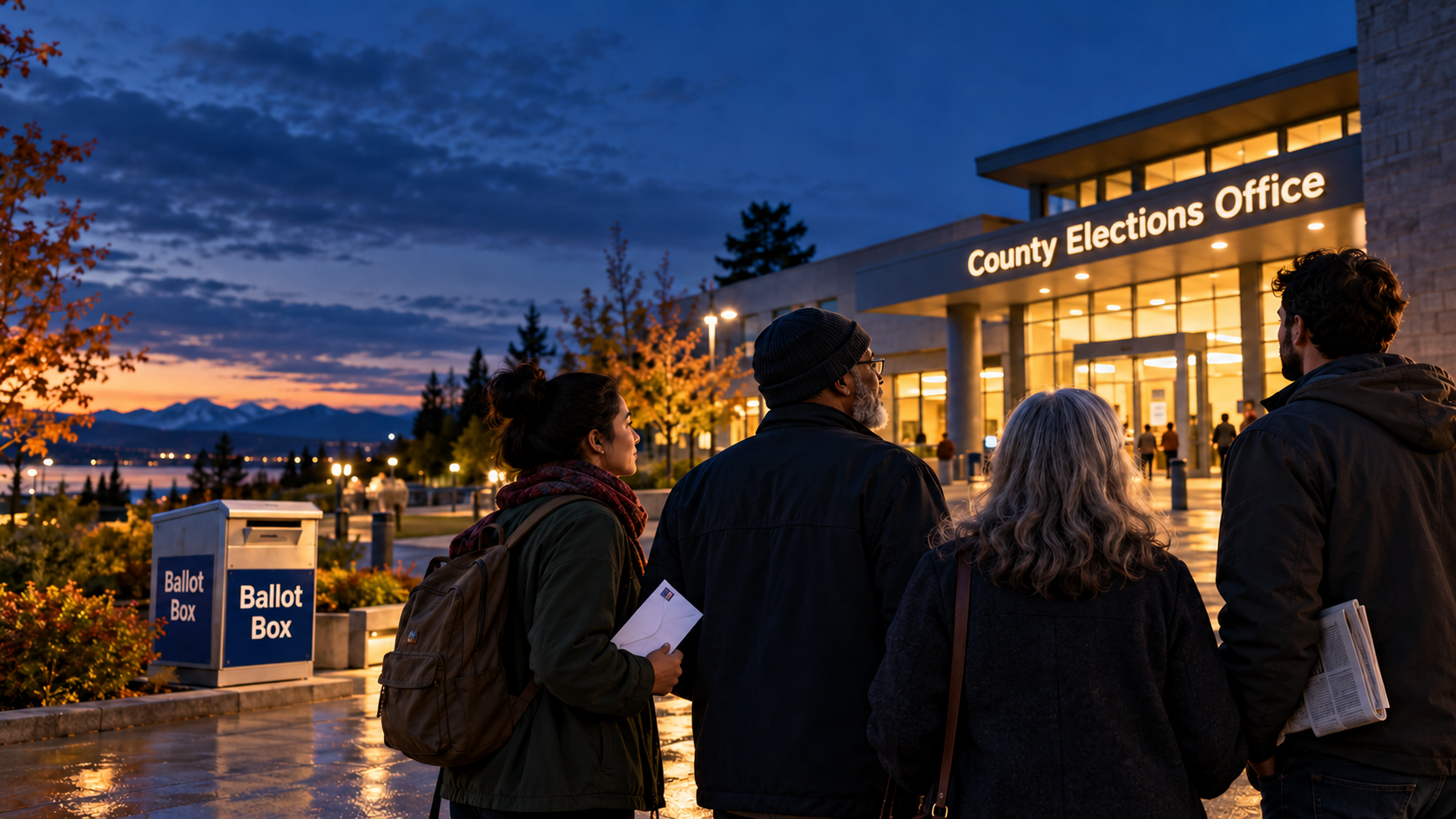
The coming election will be administered by state and local officials, including the people who count ballots here in Pierce County. They deserve cooperation, clear law and evidence—not theatrical threats from Washington, D.C. Tacoma-area voters can check their registration and ballot status through official state and county channels, use the Washington voter-rights guide, and find local help at Pierce County Elections.
We should not surrender our judgment to a press conference, a post, a frightening video clip or a government list we are not allowed to inspect. We should ask: What is the evidence? Who gets the benefit of the doubt? Who gets threatened? Who gets pardoned? And why, precisely, did this emergency arrive just before we vote?
Those questions do not make a person disloyal. They make a person a citizen.