
What the court ordered
A federal judge in California has temporarily blocked the Department of Homeland Security and its Homeland Security Investigations unit from carrying out certain voter-eligibility field operations in nine states: California, Connecticut, Georgia, Missouri, Nevada, New York, Pennsylvania, Washington and Wisconsin.
The October 21 order in California Nurses Association v. Mullin bars elections-related field operations and interviews that involve, or are likely to involve, people whom the government knows, suspects, or should reasonably suspect are U.S. citizens. It also bars operations based only on records generated through the policy at issue in the case when the same citizenship condition applies.
The order is preliminary relief, not a final decision in the lawsuit. It was stayed until 5 p.m. Pacific on October 23 and, if it takes effect, is set to last through the close of polls on November 3 unless the court changes it.
What the judge found under the Voting Rights Act
The judge concluded that the California Nurses Association and National Nurses United were likely to succeed on their claim under Section 11(b) of the Voting Rights Act of 1965. That provision prohibits any person, including someone acting under color of law, from intimidating, threatening or coercing someone for urging or helping another person to vote or attempt to vote.
The finding is precise. The court did not make a final ruling that every HSI investigation or every federal voter-fraud inquiry violates the Act. Nor did the court reach the plaintiffs’ separate claim of direct intimidation of voters themselves, because the organizations had not shown standing for that claim at this preliminary stage. The ruling concerns intimidation that interferes with voter assistance and mobilization: activities such as encouraging people to participate, election education, campaign events and poll-monitor work.
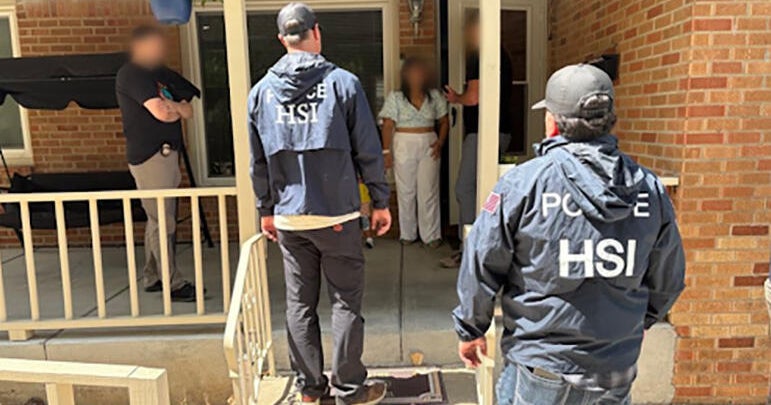
The court pointed to several factors acting together: target lists built with flawed and incomplete data that could include U.S. citizens; field interviews meant to resolve those data discrepancies; the deployment of armed agents to homes and communities; and social-media posts publicizing arrests and encounters with armed officers. The court found that those practices created an objectively reasonable fear of law-enforcement entanglement for people trying to assist and mobilize voters.
Why the timing mattered
The judge expressly considered the timing. The Surge was implemented during voter registration and early voting, in the final months and weeks before the midterm election. The court said the deployment of armed officers to homes and communities during that period had already caused some CNA/NNU members to stop attending campaign events or decline to serve as poll monitors because they feared physical, legal or reputational harm to themselves or loved ones.
That timing did not create a separate “too close to the election” rule. Instead, it helped establish irreparable harm and the public-interest balance: a lost chance to educate, mobilize or freely participate in an election cannot realistically be repaired after the vote. The court concluded that temporarily limiting the practices at issue would not stop the government from investigating actual voter fraud by lawful means.
What prompted the case
The court described a DHS “Surge Initiative” directing HSI agents to prioritize voter-eligibility investigations in those nine states. The program called for field offices to pursue leads, conduct field interviews and support prosecution review during the period of voter registration and early voting. The record identifies the nine states, but does not give a public, state-by-state explanation for why those states—and not others—were selected. The court said the lists combined government voter records with commercial data and that the program was expanded during the Surge.
Reporting and court records describe agents approaching residences for some investigations. The order itself uses the more precise terms “field operations,” “field interviews” and “interrogations”; it does not establish that agents conducted a blanket door-to-door campaign at every home or against every voter in the nine states.
According to the order, the target lists drew on tens of millions of voter records, including commercial data for some states, and agents were given short review targets. The court did not decide the plaintiffs’ separate Administrative Procedure Act claim at this stage. It did find that the unreliability of the records, the limited review time and the risk of citizens being flagged were central to the Voting Rights Act intimidation claim.
That finding is important: the court did not rule that every person on a list was eligible to vote, or that federal authorities may never investigate actual voter crimes. It ruled that the plaintiffs had met the standard for temporary relief against the operations described in this case, particularly where the government knew or should have known a person was a U.S. citizen.
Who sued, and what did they ask the court to stop?
The plaintiffs in the case that produced this order are the California Nurses Association, National Nurses United, the City and County of San Francisco, the County of Santa Clara, and the Voto Latino Foundation. They sued DHS, ICE, USCIS and related federal officials in September. Their challenge focused on the voter-matching and field-operations policies, arguing that unreliable matching could lead to investigations of citizens and deter eligible people from voting.
The California Nurses Association and National Nurses United supported their request with declarations about members who feared being identified, investigated or pressured into encounters with HSI. The federal judge did not finally decide every claim. She found that the plaintiffs had met the legal standard for a preliminary injunction: a showing, at this early stage, that they were likely to succeed on key claims and faced a risk of irreparable harm without temporary relief.
This is distinct from another, newer case filed on October 15 by the League of Women Voters, the Electronic Privacy Information Center and the League of United Latin American Citizens. That case challenges DHS’s collection and use of voter files from at least 47 states. It has not produced the nine-state field-operations order.
California’s 28 charges: related, but not the same case
On October 19, federal authorities announced Operation Protect the Vote, charging 28 people in California. The Justice Department says those defendants are lawful permanent residents, not U.S. citizens, and accused them of offenses including false statements on naturalization applications and fraudulent voter registrations. The federal action is related because it is part of the same administration-wide focus on noncitizen voting, and it relied on the same general federal investigative push.
But the 28 cases are individual criminal allegations, while California Nurses Association v. Mullin is a civil lawsuit about the lawfulness of the government’s voter-matching and field-operation policies. A charge is not a conviction. As of this draft’s publication date, the reporting reviewed for this article described the 28 defendants as charged or arrested; it did not establish final court outcomes for those cases. The Associated Press also reported that a federal prosecutor acknowledged that not every person arrested in the sweep may have voted.
The California arrests also should not be used to validate a separate list of roughly 20,000 people whom the government says are “likely” noncitizens on California’s voter rolls. California officials said they were given 48 hours to review that list and said the federal government had not supplied evidence sufficient to substantiate the broader claim. The Justice Department’s lawsuit asks a court to stop California from tabulating mail ballots from people on that list until citizenship can be confirmed. That lawsuit remains separate from the 28 criminal cases and the nine-state injunction.
The Nevada claim: from 15,903 to a verified result of zero
Nevada is a practical example of why an initial data match must not be treated as a finding. In July, DHS said a preliminary review had identified 15,903 possible noncitizens on Nevada’s voter rolls—a figure commonly reported as about 16,000, not 18,000. Federal officials later revised their estimate to 185 names.
Nevada election officials said those 185 people were likely U.S. citizens. The Associated Press subsequently reported that, after the federal government identified people to the state, the number of actual registered noncitizens identified through that review was zero. Earlier reporting also said federal officials were still considering roughly 14,000 names for further review; that means the original 15,903 claim was not a completed, verified count.
The careful conclusion is not that Nevada has proved no noncitizen has ever registered or voted. It is that the federal government’s headline-scale claim was not substantiated by the names it provided for verification, and that the first narrowed group yielded zero verified noncitizen registrants. That difference—between a data-generated lead, an election official’s verification and a criminal charge—is central to the court’s concern about error and intimidation.
The administration’s position
The Trump administration has said that noncitizens are prohibited from voting in federal elections and that HSI is investigating possible election crimes. In its recent lawsuit against California, the Justice Department said HSI and federal partners reviewed voter-registration records and used data-enrichment and verification methods to identify people who might be noncitizens.
Voting-rights and privacy organizations dispute the program’s reliability and legality. A separate lawsuit filed by the League of Women Voters, the Electronic Privacy Information Center and the League of United Latin American Citizens alleges that DHS collected voter files from at least 47 states and combined them with commercial data without adequate legal safeguards. Those allegations have not yet been finally resolved by a court.
Why the judge acted now
The court concluded that the plaintiffs had shown a likely risk of irreparable harm: eligible citizens could be investigated based on flawed data during registration and early voting, and the encounters could deter people from participating. The judge also noted that no comprehensive federal database records the citizenship status of all U.S. residents.
The decision does not decide whether noncitizen voting is a widespread problem. The order cited other federal decisions that described noncitizen voting as exceedingly rare. It does, however, require the government to respect the order’s limits while the lawsuit continues.
What this means in Washington and Pierce County
Washington is one of the nine states named in the order. That does not mean Washington voters have lost their right to vote, that their ballots are public, or that every federal election investigation has stopped. It means the court placed temporary limits on the specific field-operation practices at issue.
For practical local help, voters can confirm registration and ballot status through VoteWA, and contact Pierce County Elections promptly about a missing ballot, an address problem, or a voting-access concern. A voter who believes they are being intimidated or improperly pressured should record what happened if it is safe to do so and contact election officials or a qualified voting-rights organization for guidance.
This is a developing case. Network of Tacoma will update this report if the court modifies the order or an appeal changes its status.