
With less than three weeks before Election Day, the public is being asked to keep two ideas in view at the same time: election rolls must be accurate, and a government accusation is not proof that an eligible voter should lose a ballot.
That distinction has become harder to hold onto as the Trump administration presses states for voter information, promotes an expanded federal citizenship-checking system, and threatens consequences for officials who do not cooperate. The administration says it is enforcing laws that protect election integrity. Voting-rights groups and several state officials say the campaign risks turning imperfect data matches into last-minute barriers for lawful voters.
The facts matter because this year’s midterms are close enough for administrative failures and untested allegations to have real consequences.
Texas: a major race, and a major registration breakdown
Texas is home to one of the country’s most closely watched U.S. Senate contests. It is also where a failure in the state’s online driver’s-license system put voter registration at the center of the pre-election story.
The League of Women Voters of Texas and MOVE Texas Civic Fund alleged in an October lawsuit that the Texas Department of Public Safety had failed to transmit almost 600,000 registration records to the secretary of state for distribution to county registrars. Some records reportedly dated to October 2025.
That does not establish that 600,000 Texans were permanently denied registration, or that every record represented a new voter. The records include registration applications and updates. Texas officials said on October 15 that counties had cleared the backlog and that they were not aware of counties with remaining records to process. The state has not publicly released a final statewide total, however, and the lawsuit remains a reminder that a voter cannot use a right that an agency fails to process in time.
There is no public evidence in the reporting cited here that the Texas failure was deliberate. There is evidence of a serious systems failure: people who selected voter-registration options while renewing or updating a driver’s license had records caught in an error for months. In an election decided district by district and state by state, the difference between a delayed record and a completed registration is not a technicality.
Washington DC’s demands meet California’s deadline
The administration’s pressure campaign is broader than Texas. The Associated Press reported October 15 that the federal government has obtained voter files from at least 47 states, according to a new lawsuit challenging how the information was collected and handled. The administration disputes the suit’s allegations and says its work is aimed at detecting unlawful registration and voting.
In California, the dispute has moved from information requests to a demand with immediate consequences. On October 13, federal officials gave Los Angeles County a password-protected thumb drive containing names of people the government says are likely noncitizens who received mail ballots. The Justice Department’s October 15 complaint says the list contains more than 20,000 people statewide and asks a court to stop California from counting their mail ballots until citizenship is determined.
The word likely is doing important work. California officials have said they doubt the reliability of the federal data and note that state law already limits registration to U.S. citizens. The earlier federal letter gave the state 48 hours to identify citizens on the list and asked election officials to segregate ballots from people whose citizenship could not be independently verified. A lawsuit is an allegation, not a court finding. No court has yet established that the people on the federal list are ineligible voters.
The conflict therefore raises two separate questions. States should investigate credible evidence of ineligibility. But they must also avoid withholding a lawful ballot based on a record match that has not been verified, particularly after voting has begun.
Nevada supplied the cautionary example
Nevada shows why that verification cannot be an afterthought.
In July, Homeland Security Secretary Markwayne Mullin said that as many as 15,903 noncitizens might be registered to vote in Nevada. Federal officials later described that number as a ceiling and, after further review, sent Nevada information identifying 185 potential noncitizens.
Nevada officials reviewed those 185 records. They said every person was a U.S. citizen.
That result does not prove that no inaccurate voter record exists anywhere in Nevada. It does show that the federal claim supplied for state review did not withstand state verification. The state also said the federal government did not provide enough identifying information to independently examine the broader list in a meaningful way.
This is the basic safeguard at stake: a database match can start an inquiry, but it cannot replace one. Names, addresses, dates of birth and immigration records can be stale, incomplete or linked to the wrong person. A citizenship check that cannot survive review is not a reason to discard a ballot.
Threats do not make a weak claim stronger
The administration has not limited its approach to requests and lawsuits. In July, Mullin said state officials who did not use the administration’s revamped SAVE system or did not act on the information it provided could face fines, penalties or, depending on the circumstances, prison time. He also said states that refused cooperation could become investigation priorities.
Federal law already bars noncitizens from voting in federal elections. It also gives states, not the Department of Homeland Security, the principal responsibility for administering elections and applying their own voter-registration procedures. Whether particular federal demands are lawful will be decided in ongoing litigation. Threatening election workers before a court has resolved the underlying facts is not evidence that the facts are right.
The administration has characterized this as election security. Critics see an extraordinary attempt to nationalize voter-list enforcement shortly before an election. Both descriptions concern real questions of law and policy. The factual test is more immediate: do officials have reliable evidence, give voters notice, and provide a genuine chance to correct an error before a ballot is withheld or a registration is canceled?
Old claims, new election season
President Donald Trump has continued to describe American elections as vulnerable to fraud and has revived claims associated with his false account of the 2020 election. In his July 16 address on election security, he alleged broad vulnerabilities and cited a federal estimate of roughly 278,000 noncitizens registered across four states.
Independent fact checks and reporting found that the address supplied no evidence of widespread fraudulent voting, and that several of its central claims repeated allegations previously rejected by audits, investigations and courts. The president’s documents did not substantiate the promised proof of mass fraud. Nevada’s subsequent review of the 185 names it received offers a concrete example of why such claims require checking before they are repeated as fact.
It is fair to debate voter-list maintenance, citizenship verification and ballot procedures. It is not responsible to treat an unverified list, a political speech or a database hit as a finding that a person voted illegally. The lesson of 2020 was not that election claims should be ignored; it was that extraordinary claims must be tested in public, with evidence, and subjected to the rule of law.
A badge at the ballot box—and the fear it can create
An election site should not feel like a checkpoint. Yet public discussion of immigration agents at the polls, along with the Justice Department’s large planned monitoring operation, has made that question urgent for many voters.
The facts require care. The Department of Homeland Security says it has no plan to station immigration officers at polling places for the November midterms. The Justice Department says its election monitors are meant to enforce federal voting-rights laws, not to act as partisan poll watchers. There is no evidence that armed ICE agents are being deployed nationwide to polling sites.
At the same time, the Justice Department has said it plans to send about 1,000 election monitors to polling locations during the midterms—a substantial increase from the 289 reported for the 2022 midterms. Federal monitoring can be lawful and valuable: the Voting Rights Act and other federal laws prohibit discrimination and voter intimidation. A trained, clearly identified monitor who observes procedures and reports a problem is not the same as a partisan poll watcher who challenges voters or a law-enforcement officer who conducts an investigation.
But scale, timing and rhetoric shape how a presence is received. Monitors should have a clear lawful role, avoid questioning voters, and never interfere with the people they are supposed to protect.
The prospect of armed officers also has a legal boundary. Federal law generally prohibits federal officials from bringing troops or armed men to a place where an election is being held, except in the extraordinary circumstance of repelling armed enemies of the United States. Other federal and state laws prohibit intimidation, threats and interference with voting. The application of those laws can be fact-specific—particularly around early-voting centers, drop boxes and election offices—but a badge does not erase a voter’s right to cast a ballot free from coercion.
Wisconsin election officials have issued guidance for what to do if ICE, DHS, FBI, or local law-enforcement officers arrive at a poll. Associated Press reporting also documented 2026 incidents involving immigration officers or vehicles near voting sites in Texas, California and New York. Those episodes do not establish a nationwide deployment. They do explain why election officials are planning for one.
When anti-immigrant rhetoric reaches citizens
Only U.S. citizens may vote in federal elections. That rule should be enforced with accurate evidence and due process. It should not become a reason to treat someone as suspicious because of an accent, a name, a neighborhood, a language, or an immigration history.
The administration’s voter-roll campaign has focused heavily on claims that large numbers of noncitizens are registered or voting. As Nevada showed, a claim has to survive review before it can responsibly be used against individual voters: every one of the 185 voters DHS identified there for state review was found to be a U.S. citizen.
The harm reaches beyond people who are wrongly flagged. A naturalized citizen may worry that a database has not caught up with a change in status. A U.S.-born citizen in a mixed-status family may fear that an encounter with an officer could expose a parent, spouse, child or neighbor to immigration enforcement. A voter with limited English proficiency may have less ability to distinguish an official instruction from a threatening rumor. None of those concerns makes a person less entitled to vote.
Immigrants are not one political bloc. They include citizens, lawful permanent residents, refugees, visa holders, people without legal status, and families with more than one status in the same home. Only eligible citizens vote in federal elections. Treating an entire community as presumptively fraudulent is inaccurate and creates a pathway to discrimination.
How intimidation works without an arrest
Voter intimidation is not limited to a physical blockade. It can include an armed or uniformed presence intended to frighten people; aggressive questions about citizenship or identification; photographing or recording voters; unsupported eligibility challenges; threats of arrest, deportation or penalties; and knowingly false instructions about who may vote or how.
Its effect is often indirect. People may decide not to register, not to volunteer as a poll worker, not to accompany a relative to a voting site, or not to use a drop box they believe is being watched. They may avoid seeking help when a ballot is challenged. Those choices are difficult to count because the person deterred may never appear in an election record.
Research supports taking the risk seriously without claiming it determines every voter’s decision. A peer-reviewed study using 2002–2014 Census voting data found that intensified interior immigration enforcement was associated with a five-percentage-point lower registration rate among U.S. citizens living in mixed-status households. That study does not predict a precise turnout effect in 2026. It does provide evidence that an enforcement climate can affect civic participation by citizens who are legally eligible to participate.
Some people answer a threat by voting, organizing or volunteering; others withdraw because the risk feels too immediate. A responsible election system should not depend on testing which response fear produces.
A response built on rights, not fear
The national No Kings coalition has called for a nationwide day of action on Saturday, October 17, focused on early voting and election protection. Organizers say the events are nonviolent and nonpartisan and ask participants not to bring weapons. Earlier No Kings demonstrations drew millions of participants by organizers’ estimates; no independent turnout estimate for October 17 exists in advance of the event.
The First Amendment protects peaceful speech, assembly and petition. It does not require anyone to agree with a rally, a president or an election policy. It does require public officials to respect the rights of people who lawfully speak, organize and vote.
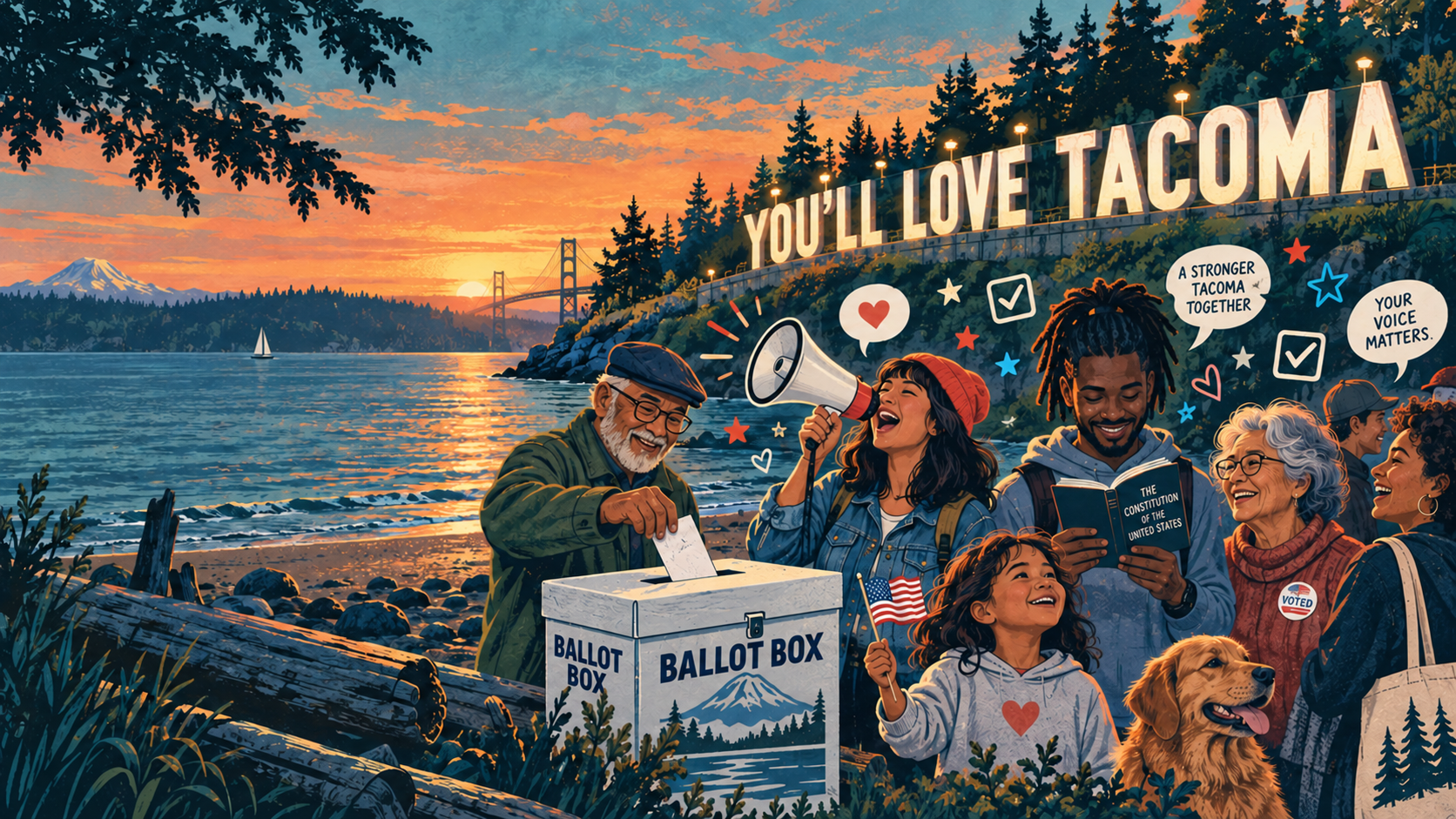
For Tacoma-area voters, the most useful response is practical: verify your registration and ballot status through official state or county channels, read the Washington voter-rights guide, and use Pierce County Elections for local deadlines and ballot information. If a voter is told there is a problem, they should seek written information, ask what record supports it, and learn the available cure or challenge process.
If someone threatens, follows, blocks, photographs, or gives false instructions to a voter, document what can be documented safely and report it to election officials. Do not confront a law-enforcement officer at a voting site; ask a poll worker or election official for help and use official reporting channels.
Election security worthy of the name protects both sides of the same right: the public’s right to accurate administration and each eligible citizen’s right to cast a ballot that is counted. Pressure is not proof. And fear is not a substitute for due process.